
Are glucose spikes in a healthy person a reason to worry?

Sonia Biecka
Dietitian

Medical review: lek. Wojciech Sierocki
Content medically reviewed by an Optimals team physician.

The sensor trace looks perfect for most of the day. Then you eat oatmeal with fruit and glucose starts to climb. 110 mg/dL, 130 mg/dL, 145 mg/dL. The app shows an unmistakable peak.
That does not necessarily mean something bad just happened.
As continuous glucose monitoring has grown more popular over the last few years, more and more people without diabetes have started watching their glycemia almost minute by minute. Something that used to be completely invisible is suddenly on a phone screen. But seeing a phenomenon does not make it abnormal.
Glucose is supposed to rise after a meal. What matters is less whether there was a spike than how high it was, how long it lasted, how often it repeats, and what the whole metabolic context says about it.
Glucose is allowed to rise after a meal
When you eat a meal containing carbohydrates, they are digested into glucose, among other things, which then enters the bloodstream.
The pancreas responds by releasing insulin. Thanks to insulin, glucose can be taken up by muscle and other tissues, or stored, largely as glycogen.
A rise in glucose after eating is therefore a normal physiological response.
A healthy body is not aiming for a perfectly flat glucose line around the clock. Levels rise after meals and then come back down.
In a study of people without diabetes, average pre-meal glycemia was around 93 mg/dL, while the average post-meal peak was around 143 mg/dL.
This shows that crossing 140 mg/dL on a sensor does not automatically mean a carbohydrate metabolism disorder.
So is 140 mg/dL after a meal always fine?
This is where one of the biggest problems with interpreting sensor data begins.
Online you will find very specific instructions:
"Glucose should never exceed 140 mg/dL."
"A healthy person should see a maximum rise of 30 mg/dL."
"Every glucose spike damages your blood vessels."
Universal cut-offs like these cannot currently be treated as binding diagnostic criteria for a healthy population.
Research shows that in people without diabetes, transient values above 140 mg/dL can occur after meals. At the same time, people with normal carbohydrate metabolism spend the vast majority of the day at lower values.
Far more important than any single peak is therefore the overall glycemic pattern.
A brief rise after lunch, after which glucose returns fairly quickly to baseline, is interpreted very differently from regularly occurring, high and long-lasting post-meal values.
A "glucose spike" is not a medical diagnosis
The term "glucose spike" has become extremely popular, but on its own it is not a diagnosis of disease.
Neither diabetes nor prediabetes is diagnosed on the basis of a CGM app showing 150 mg/dL after breakfast.
According to the 2026 American Diabetes Association standards, there is insufficient evidence to use CGM for diagnosing or screening for diabetes and prediabetes. Diagnosis still rests on standardised laboratory tests.
Those include, among others:
- fasting glucose,
- glycated haemoglobin HbA1c,
- the oral glucose tolerance test, or OGTT.
In specific situations a doctor may recommend further testing. If you want to know how to read those results together, we cover it in our piece on insulin, glucose, HOMA-IR and HbA1c.
A sensor can provide interesting information, but it should not replace properly performed laboratory tests.
A sensor does not measure blood glucose directly
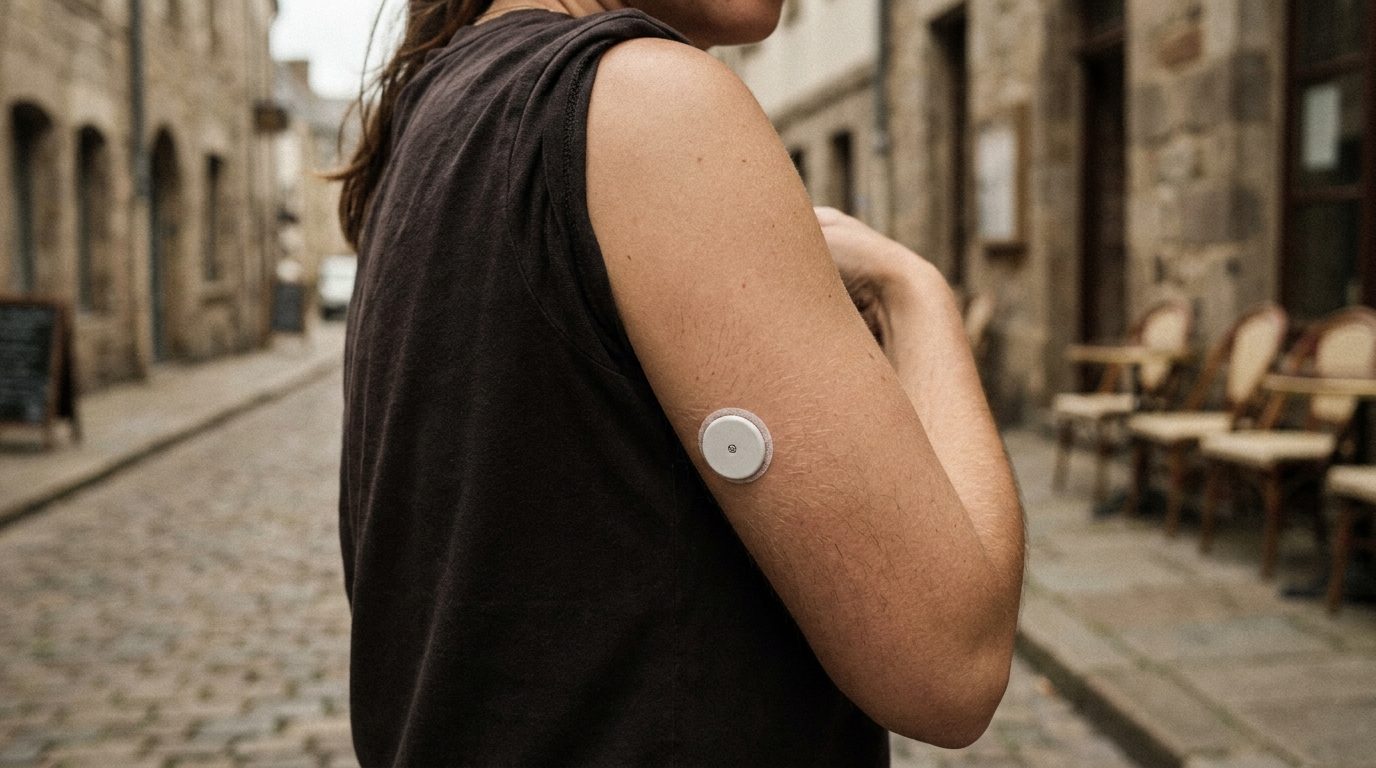
CGM measures glucose concentration in interstitial fluid, not directly in blood.
The value shown in the app can therefore differ from your actual glycemia measured in a lab or with a glucometer. This matters especially when glucose is rising or falling quickly.
Devices keep getting more accurate, but they are still not free of measurement error. A 2024 systematic review found good accuracy for current CGM systems mainly in the normal and elevated glucose range, with greater limitations at low glycemia.
In one study, participants wore two CGM sensors at the same time. The response to the same meal was not always classified identically by both devices. The authors pointed out that this may limit how categorically foods can be labelled "good" or "bad" purely on the basis of small differences in sensor-derived glycemic response.
So the difference between 132 and 145 mg/dL should not automatically trigger a complete rebuild of your diet.
Why can the same meal produce a different response?
The glycemic response does not depend solely on how much sugar a product contains.
Things that matter include: the amount and type of carbohydrate, fibre, protein and fat content, how processed the product is, cooking method - frying affects a food differently than boiling does - portion size, physical activity, and individual variation.
That is why a banana eaten on its own can produce a different response than the same banana added to plain yoghurt, oats and nuts.
A 2024 meta-analysis showed, for example, that adding protein to a carbohydrate meal can reduce the post-meal glycemic response in people without diabetes.
That does not mean every meal has to be engineered purely to produce the flattest possible curve.
Glycemic response is one of many markers of diet quality, not its only measure.
Can large glucose swings matter for health?
Research indicates that people with prediabetes have, on average, greater glycemic variability than people with normal carbohydrate metabolism.
A 2024 systematic review and meta-analysis covering 71 studies found greater glycemic variability in people with prediabetes. It was also associated with poorer pancreatic beta-cell function.
That does not mean every post-meal rise in a healthy person is harmful.
The authors of the same analysis stressed that the link between glycemic variability and many classic metabolic risk factors, including obesity, lipids, blood pressure and insulin resistance, remains unclear. We also need more prospective studies to establish which CGM parameters actually predict disease in people without diabetes.
So there is currently no basis for treating every glucose peak as a risk factor in its own right.
Should a healthy person wear a CGM?
There is no need. CGM is an extremely valuable tool in diabetes care. Current ADA guidelines recommend it primarily for specific groups of people with diabetes, especially those treated with insulin or with therapies that can cause hypoglycaemia.
Increasingly, though, sensors are also used by people without diabetes as part of lifestyle monitoring.
That can teach you something: you can see how your body responds to particular meals, to activity, or to meal timing.
The problem starts when a diagnostic tool begins to dictate every dietary decision.
The most recent systematic review of CGM in people without diabetes, published in 2026, covered 23 studies and 1,074 participants. CGM could support short-term changes in eating behaviour, but in healthy people with normal glycemia no clear metabolic benefit from wearing a sensor was demonstrated. More data does not always mean better health.
Do not judge a food by its glucose curve alone
Picture two products.
The first produces an almost flat glucose curve, but is an energy-dense, highly processed product with little fibre and few micronutrients.
The second is a piece of fruit that produces a more pronounced glucose rise.
If peak height were our only criterion, we would conclude that the first product is "healthier".
Yet a food's nutritional value is determined by far more than that.
What counts includes fibre, protein and unsaturated fat content, vitamins, minerals, degree of processing, energy density, and the effect of the whole diet on health.
For the same reason, isolated tricks such as apple cider vinegar before a meal change the metabolic picture far less than the internet suggests.
The lowest possible glucose peak should not be the overriding goal of a healthy person's nutrition.
Do you have to avoid fruit, oatmeal or potatoes if they raise glucose?
No. If you do not have a carbohydrate metabolism disorder, the mere fact that glucose rises after a carbohydrate-containing food is not an argument for cutting it out.
Fruit, wholegrain cereals, legumes and potatoes can all be part of a healthy way of eating.
A far better strategy than eliminating one food after another is looking after the overall quality of the meal.
Oatmeal can be combined with skyr or yoghurt, fruit and nuts. Bread with egg, cottage cheese or hummus and vegetables. Rice or potatoes with vegetables and a source of protein.
The point is to put together complete meals in the ordinary way, not to "neutralise" every gram of carbohydrate.
What about a walk after a meal?

Here the data is quite good. Muscle activity increases glucose uptake, so even relatively modest activity after a meal can blunt the post-meal rise in glycemia.
A 2023 meta-analysis found that activity started after eating reduced post-meal glucose rises, both compared with no activity and with activity performed before the meal. The effects were more favourable when movement came relatively soon after eating.
That does not mean you have to pace around your flat for 20 minutes after every meal just to "flatten glucose".
A walk after lunch has far more going for it than its effect on a CGM trace, and that is the context to keep it in.
When is glycemia worth a closer look?
A single high sensor reading is not grounds for a diagnosis.
It is worth paying more attention when abnormal values repeat regularly, or when other diabetes risk factors are present: excess body weight, type 2 diabetes in the family, previous gestational diabetes, or abnormal earlier test results.
Symptoms such as increased thirst, frequent urination, unexplained weight loss or a marked deterioration in wellbeing can also be concerning.
In those situations, rather than analysing yet more charts in an app, it is worth doing the appropriate laboratory testing and discussing the results with a doctor.
Summary
Glucose after a meal does not have to be flat.
A rise after eating carbohydrates is a physiological response, accompanied by an insulin response and glucose uptake by tissues.
A single peak on a CGM trace does not mean diabetes, insulin resistance, or that the food you just ate is "bad" for you.
What matters far more is the whole picture: lab results, average glycemia, whether abnormal values repeat, risk factors, lifestyle and general health.
Technology now lets us see far more data about our bodies, but the useful skill is knowing which information actually matters, not measuring everything.
Frequently asked questions
Should glucose stay at the same level all the time?
No. In a healthy person glucose changes throughout the day, in response to meals, activity and periods without food. A perfectly flat line is not a physiological goal.
Does glucose above 140 mg/dL after eating mean prediabetes?
No. A single CGM value above 140 mg/dL cannot diagnose prediabetes. In healthy people, transient values above that level can appear after a meal. Diagnosing prediabetes relies on standardised laboratory tests.
Does every glucose spike cause an insulin surge?
A rise in glucose after a carbohydrate meal physiologically leads to increased insulin secretion. That is the normal mechanism allowing the body to use glucose. An insulin rise after eating is therefore not evidence of insulin resistance.
Should you eliminate a food if it causes a large glucose rise?
Not on the basis of a single reading. The response can change with portion size, the composition of the whole meal, activity and many other factors. The sensor itself also carries measurement error.
Do you need vinegar before a meal to lower glucose?
A healthy person does not need "glucose hacks" before every meal. Overall diet quality, physical activity, healthy body weight, sleep, and limiting tobacco and excess alcohol matter far more for metabolic health.
Does a walk after a meal help lower glucose?
Yes. Studies show that activity performed after a meal can reduce the post-meal glycemic response. That does not mean a healthy person has to walk after every meal to control every rise in glucose.
Does a healthy person need a CGM sensor?
Usually not. CGM can be an interesting educational tool, but there is currently insufficient evidence to routinely recommend it for healthy people with normal carbohydrate metabolism. It should also not be used on its own to diagnose diabetes or prediabetes.
References
- Freckmann G. et al. Continuous glucose profiles in healthy people with fixed meal times and under everyday life conditions. Journal of Diabetes Science and Technology, 2022. doi:10.1177/19322968221113341.
- Merino J. et al. Validity of continuous glucose monitoring for categorizing glycemic responses to diet: implications for use in personalized nutrition. American Journal of Clinical Nutrition, 2022;115(6):1569–1576. doi:10.1093/ajcn/nqac026.
- Jarvis P.R.E. et al. Continuous glucose monitoring in a healthy population: understanding the post-prandial glycemic response in individuals without diabetes mellitus. Metabolism, 2023;146:155640. doi:10.1016/j.metabol.2023.155640.
- Engeroff T., Groneberg D.A., Wilke J. After dinner rest a while, after supper walk a mile? A systematic review with meta-analysis on the acute postprandial glycemic response to exercise before and after meal ingestion in healthy subjects and patients with impaired glucose tolerance. Sports Medicine, 2023;53:849–869. doi:10.1007/s40279-022-01808-7.
- Oganesova Z., Pemberton J., Brown A. Innovative solution or cause for concern? The use of continuous glucose monitors in people not living with diabetes: a narrative review. Diabetic Medicine, 2024;41(9):e15369. doi:10.1111/dme.15369.
- Glycemic variability assessed using continuous glucose monitoring in individuals without diabetes and associations with cardiometabolic risk markers: a systematic review and meta-analysis. 2024. doi:10.1016/j.clnu.2024.02.014.
- The effect of adding protein to a carbohydrate meal on postprandial glucose and insulin responses: a systematic review and meta-analysis of acute controlled feeding trials. 2024. doi:10.1016/j.tjnut.2024.07.011.
- Evaluating the precision and reliability of real-time continuous glucose monitoring systems in ambulatory settings: a systematic review. 2024. doi:10.1177/20420188241304459.
- American Diabetes Association. Standards of Care in Diabetes 2026: diagnosis and classification of diabetes. Diabetes Care, 2026. doi:10.2337/dc26-s002.
- American Diabetes Association. 7. Diabetes technology: Standards of Care in Diabetes 2026. Diabetes Care, 2026;49(Suppl 1):S150. doi:10.2337/dc26-s007.
- Continuous glucose monitoring in non-diabetic populations: a systematic review of observational and interventional studies with meta-analysis. 2026. doi:10.1186/s40001-026-03920-0.