
Visceral fat: why it matters more than the number on the scale

Sonia Biecka
Dietitian

Medical review: lek. Wojciech Sierocki
Content medically reviewed by an Optimals team physician.

Two people can weigh exactly the same, be a similar height, and even have an identical BMI. Yet their risk of developing type 2 diabetes, cardiovascular disease or lipid disorders can be completely different.
One of the reasons is where the body stores fat tissue.
Fat tissue sitting under the skin is not metabolically the same thing as fat accumulating deep inside the abdominal cavity, around the internal organs. The second kind is called visceral fat, or visceral adipose tissue, VAT.
More and more data show that for metabolic health it matters not only how much fat tissue we have, but also where it is located and how it functions. That is why obesity is now increasingly diagnosed with more than body weight and BMI.
What exactly is visceral fat?
Fat tissue around the abdomen can, in simplified terms, be divided into two main types.
Subcutaneous fat tissue sits directly under the skin. It is the fat we can pinch between our fingers on the stomach, hips or thighs.
Visceral fat tissue sits much deeper, inside the abdominal cavity, between and around organs such as the intestines or the liver.
The difference is not only anatomical.
Fat tissue is an active metabolic and hormonal organ. Fat cells secrete numerous compounds that influence, among other things, glucose and insulin metabolism, inflammation and the functioning of the cardiovascular system. Excessively expanded visceral tissue shows a particularly unfavourable metabolic profile.
Why is visceral fat more problematic?
Visceral fat is not simply "a store of calories tucked away in the belly".
When it accumulates excessively, a series of changes follows that can affect the whole body.
1. It is strongly linked to insulin resistance
Visceral tissue is characterised by high lipolytic activity. This means it releases free fatty acids relatively easily.
Because of where it sits, part of these compounds travels directly through the portal circulation to the liver. An excess of them can promote disturbances in lipid and glucose metabolism and the development of insulin resistance.
Dysfunctional fat tissue also takes part in chronic low-grade inflammation, which can further disturb the action of insulin.
In practice this means that a person with a large amount of visceral fat may be more prone to elevated glucose levels, an abnormal insulin response or the development of type 2 diabetes. You will find more on how to recognise this state and what to do about it in our article on insulin resistance and its symptoms.
A meta-analysis published in 2024 showed that higher values of the visceral adiposity index were associated with a greater risk of developing type 2 diabetes.
2. It promotes lipid disorders
Excess visceral fat often coexists with a metabolic profile that includes:
- elevated triglyceride levels,
- reduced HDL cholesterol levels,
- increased production of apoB-containing lipoproteins,
- a greater tendency to deposit fat in other organs.
When the capacity for safe energy storage in subcutaneous tissue is exceeded, fat can start to accumulate in places where physiologically there should be very little of it, for example in the liver, muscles, pancreas or around the heart.
We then speak of ectopic fat. An excessive amount of it is closely linked to metabolic disorders.
3. It is linked to a higher risk of cardiovascular disease
This is one of the best described problems associated with visceral obesity.
In an analysis of UK Biobank data covering more than 24 thousand people, the amount of visceral fat was assessed using magnetic resonance imaging. The mean follow-up was almost 13 years.
Every increase in VAT by one standard deviation was associated with roughly 15% higher risk of coronary heart disease. The association remained visible even after accounting for waist circumference.
This does not mean that visceral fat by itself "causes a heart attack". Cardiovascular risk is the result of many factors. Research does indicate, however, that the location of fat tissue provides additional information that we do not get from looking at body weight alone.
The most recent reviews from 2026 also emphasise that what may matter is not only the amount in each fat depot, but also its biological activity and degree of dysfunction.
The same body weight does not mean the same risk

This is the biggest limitation of an ordinary scale.
A scale shows one thing: how much the whole body weighs.
It does not tell us:
- how much of that mass is muscle,
- how much of it is fat tissue,
- where that fat tissue is located,
- how much fat has accumulated around the organs,
- whether there is fatty liver,
- whether the fat tissue is metabolically dysfunctional.
A similar problem applies to BMI.
BMI is a very simple and useful screening tool, especially in population studies, but it does not allow us to determine how fat tissue is distributed.
So it is possible to have a normal BMI and at the same time relatively a lot of visceral fat. The reverse is also possible, where a person with a higher BMI has a comparatively more favourable fat distribution.
A study using UK Biobank data, which assessed more than 36 thousand people, illustrated this well. A greater amount of visceral fat was associated with higher risk of atherosclerotic cardiovascular disease across different BMI categories, and the association was particularly clear in people without obesity by the classic BMI criterion.
This is one of the reasons why modern guidelines increasingly say: do not look at BMI alone.
Can you have a normal body weight and too much visceral fat?
Yes.
A normal body weight does not guarantee a normal body composition or a normal distribution of fat tissue.
Where we store fat is influenced by many factors, among them:
- genetics,
- age,
- sex,
- hormonal status,
- menopause,
- level of physical activity,
- energy balance,
- the way we eat,
- alcohol intake.
This is why two people with an identical BMI can differ significantly in the amount of visceral fat. We cover hormonal changes in more depth in our article on perimenopause and body weight.
Medicine is therefore increasingly moving away from treating BMI as a tool that on its own settles the question of health. Both the European EASO recommendations from 2024 and the international Lancet Commission from 2025 point to the need to take into account additional parameters relating to the amount and distribution of fat tissue and to the presence of its health consequences.
How do you check whether you have too much visceral fat?
There is no need to go straight to an MRI.
Waist circumference
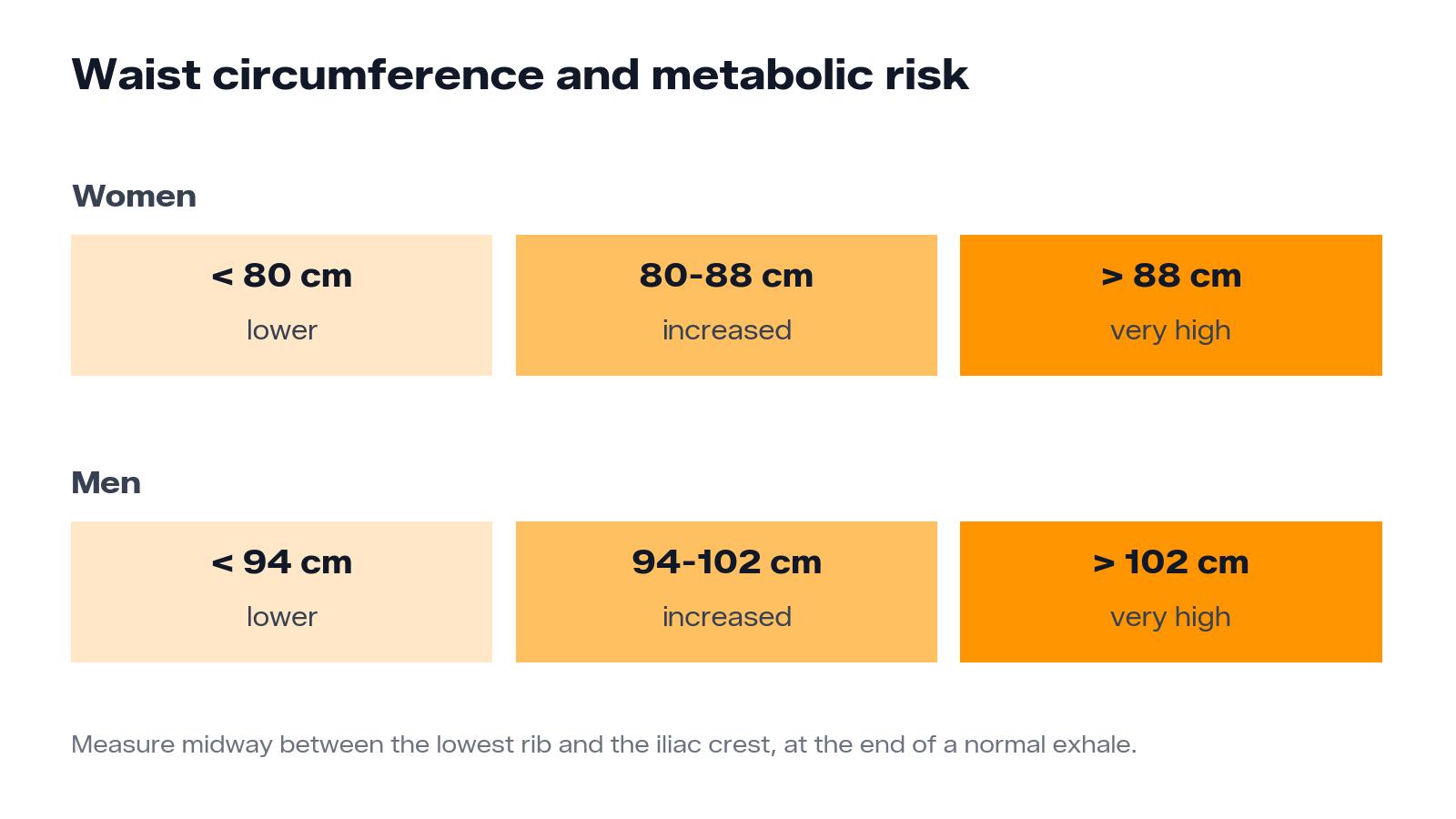
One of the simplest tools is measuring waist circumference.
Polish recommendations on the dietary treatment of obesity from 2024 indicate that in the European population the values are:
in women:
- below 80 cm means lower risk,
- 80–88 cm means increased risk,
- above 88 cm means very high risk,
in men:
- below 94 cm means lower risk,
- 94–102 cm means increased risk,
- above 102 cm means very high risk.
Waist circumference does not measure the amount of visceral fat directly, but it is an easy and clinically useful indicator of abdominal obesity.
Waist-to-height ratio
Another simple parameter is the waist-to-height ratio, WHtR, that is, waist circumference divided by height.
An example:
waist circumference 85 cm height 170 cm
85 ÷ 170 = 0.50
A value of 0.5 and above indicates increased metabolic risk. In Polish recommendations, values of 0.5–0.59 are described as associated with elevated health risk, and values from 0.6 upwards with a significant risk of metabolic complications.
MRI and computed tomography
The most accurate information about fat distribution can be obtained using imaging methods, especially magnetic resonance imaging and computed tomography.
They can separate subcutaneous from visceral tissue and determine its amount precisely. They are not, however, performed routinely just to check the level of visceral fat. They are more expensive, less available, and tomography additionally involves exposure to radiation.
What about scales that analyse body composition?
Scales using bioelectrical impedance often report a parameter described as "visceral fat" or "visceral fat level".
The device does not see the fat around the organs. The result is estimated on the basis of electrical measurements and the manufacturer's algorithm.
Studies comparing bioimpedance with tomography or MRI show that its accuracy in assessing VAT is limited and depends, among other things, on the device and the algorithm used.
Newer data from 2026 indicate that in clinical practice a simple waist measurement can be a very useful surrogate indicator of visceral fat.
This is why a single "visceral fat 8" or "visceral fat 12" reading from a home scale should not be treated as a diagnosis.
Can visceral fat be reduced?
Yes, and that is the good news.
Visceral tissue can respond to lifestyle change, which is why reducing it is one of the important outcomes of treating excess body weight and metabolic disorders.
Physical activity
Regular physical exercise has a favourable effect on the amount of visceral fat tissue.
Reviews of the research indicate that training can reduce VAT even when the change in body weight is not spectacular. This is another example of why the absence of a large drop in kilograms does not automatically mean an absence of health effects.
In a 2026 meta-analysis covering 60 randomised trials and more than 3300 people with overweight or obesity, various forms of physical activity led to a reduction in visceral fat tissue.
So when reducing abdominal obesity, think of regular movement as something that improves metabolism, not only as a way of "burning calories". If you are looking for a starting point, our guide to strength training for women will help.
The way you eat
There is no single product, supplement or specific ingredient that selectively "burns belly fat".
What matters is the whole way of eating.
A 2024 systematic review covering 35 observational studies indicated that higher diet quality was generally associated with a smaller amount of visceral fat tissue.
In practice this means above all a diet based on:
- vegetables and fruit,
- wholegrain products,
- legume seeds,
- an adequate protein intake,
- nuts and seeds,
- sources of unsaturated fatty acids,
- food that is as minimally processed as possible.
How meals are prepared matters too: frying often in large amounts of fat makes it easier to end up with a calorie surplus than boiling or baking does.
At the same time, in the case of excess body weight, adjusting energy intake to individual needs remains important.
Different dietary strategies can lead to a reduction in visceral fat if they enable a long-term improvement in diet quality and, where needed, an appropriate energy deficit. There is no need to follow one specific "visceral fat diet".
Why does a centimetre sometimes say more than a kilogram?
Imagine a person who over several months:
- starts training regularly,
- increases the amount of movement during the day,
- changes the way they eat,
- improves their body composition,
- reduces their waist circumference by 7 cm,
- improves their glucose and triglyceride levels,
but sees only 2 kg less on the scale.
Does that mean a poor result?
No.
Change in body weight is only one parameter. If at the same time waist circumference is falling and body composition, metabolic parameters and fitness are improving, the body may be going through very significant health changes that an ordinary scale cannot show. We cover the other reasons weight stops dropping despite diet and exercise in a separate article.
That is why, in assessing the effects of lifestyle change or treatment, watch more than the kilograms:
- waist circumference,
- waist-to-height ratio,
- body composition, if we have a way to assess it reliably,
- blood pressure,
- glycaemia and HbA1c,
- the lipid profile,
- liver parameters,
- physical fitness and capacity.
We explain how to read some of these results in our article on insulin, glucose, HOMA-IR and HbA1c.
Summary
The number on the scale is not meaningless. The problem starts when we try to judge the body's entire metabolic state on the basis of it.
A kilogram does not tell us where the fat tissue is.
And that distribution may be one of the main factors influencing the risk of type 2 diabetes, lipid disorders, liver disease or cardiovascular disease.
That is why, instead of asking only:
"How much do you weigh?"
it makes sense to also ask:
"What is your waist circumference, what does your body composition look like and what do your test results say?"
Frequently asked questions
Does belly fat always mean a lot of visceral fat?
No. A large part of the visible fat tissue on the abdomen may sit under the skin. Appearance alone does not tell you how much fat is inside the abdominal cavity. This is why a properly taken waist measurement is more useful, and in particular situations body composition tests or imaging methods.
Can you have a lot of visceral fat with a normal BMI?
Yes. BMI does not show how fat tissue is distributed. Research shows that people without obesity by BMI can also have an increased amount of VAT and the elevated cardiovascular risk that comes with it.
Can visceral fat be burned with abdominal exercises?
No. Crunches can strengthen the abdominal muscles, but the body does not reduce fat tissue only in the area currently being trained. Reducing visceral fat comes above all from regular physical activity, an appropriate way of eating and, where there are medical indications, comprehensive obesity treatment.
Is cardio best for visceral fat?
Aerobic activity is an effective element of reducing visceral fat, but that does not mean you have to limit yourself to cardio alone. Different forms of training bring good results. In practice the most sensible solution is usually a combination of aerobic activity, strength training and more everyday movement.
If body weight does not drop, does that mean visceral fat is not decreasing?
Not always. Changes in body composition can occur even with a relatively small change in body weight. Regular physical activity can reduce the amount of visceral fat while helping to maintain or increase muscle mass.
What waist circumference is normal?
In the European population, the values usually taken as associated with lower risk are below 80 cm in women and below 94 cm in men. Risk rises above these values, and a circumference exceeding 88 cm in women and 102 cm in men is associated with very high metabolic risk. Waist circumference is still worth interpreting alongside other parameters, among them height, BMI, test results and the presence of metabolic disease.
Can a home scale measure visceral fat accurately?
No. A scale using bioimpedance can only estimate the amount. The result depends on the device, the algorithm used and the measurement conditions. It is not equivalent to assessing visceral fat with MRI or tomography.
Which matters more: BMI or waist circumference?
You do not have to choose one of them. Interpreting them together gives the most information. BMI helps assess body weight in relation to height, while waist circumference provides additional information about abdominal obesity. This is exactly the approach now recommended by EASO and by the Polish obesity treatment recommendations, among others.
References
- Busetto L. et al. A new framework for the diagnosis, staging and management of obesity in adults. Nature Medicine, 2024. doi:10.1038/s41591-024-03095-3.
- Rubino F. et al. Definition and diagnostic criteria of clinical obesity. The Lancet Diabetes & Endocrinology, 2025. doi:10.1016/s2213-8587(24)00316-4.
- Bennett J.P., Prado C.M., Heymsfield S.B., Shepherd J.A. Evaluation of visceral adipose tissue thresholds for elevated metabolic syndrome risk across diverse populations: A systematic review. Obesity Reviews, 2024. doi:10.1111/obr.13767.
- Yi D., Tang X., Xing Z. Visceral and subcutaneous adiposity and cardiovascular disease: Unravelling associations and prognostic value. Diabetes, Obesity and Metabolism, 2024. doi:10.1111/dom.15953.
- Thimm A., Maskarinec G., Guillermo C., Nimptsch K., Pischon T. A systematic review of observational studies on the association between diet quality patterns and visceral adipose tissue. British Journal of Nutrition, 2024. doi:10.1017/s000711452400179x.
- Wang D., Morton J.I., Salim A., Magliano D.J., Shaw J.E. Comparison of DXA, BIA, and anthropometry for assessing subcutaneous, visceral, liver, and pancreas fat measured by MRI. Diabetes, Obesity and Metabolism, 2026. doi:10.1111/dom.70456.
- Hoffmann J. et al. A new approach to quantify visceral fat via bioelectrical impedance analysis and ultrasound compared to MRI. International Journal of Obesity, 2024. doi:10.1038/s41366-023-01400-7.
- Xu Z. et al. Measurement of visceral fat and abdominal obesity by single-frequency bioelectrical impedance and CT: a cross-sectional study. BMJ Open, 2021. doi:10.1136/bmjopen-2020-048221.
- Abe T. et al. Comparisons of calorie restriction and structured exercise on reductions in visceral and abdominal subcutaneous adipose tissue: a systematic review. European Journal of Clinical Nutrition, 2022. doi:10.1038/s41430-021-00942-1.
- Chang Y. et al. Unveiling the perfect workout: exercise modalities and dosages to combat visceral adipose tissue in individuals with overweight and obesity: a systematic review with pairwise, network, and dose-response meta-analyses. Nutrition & Metabolism, 2026. doi:10.1186/s12986-026-01129-w.
- Khalafi M. et al. The efficacy of carbohydrate-restricted diets on reducing visceral and liver fat in individuals with overweight and obesity: a systematic review and pairwise and network meta-analyses. Critical Reviews in Food Science and Nutrition, 2026. doi:10.1080/10408398.2026.2681938.
- Khanna S. et al. Role of systemic and epicardial adipose tissue in cardiometabolic disease. Nature Reviews Cardiology, 2026. doi:10.1038/s41569-026-01304-9.
- Gajewska D. et al. Recommendations on dietary treatment of obesity in adults: 2024 position of the Polish Society of Dietetics. Journal of Health Inequalities, 2024. doi:10.5114/jhi.2024.141201.