
Protein for Women: How Much Do You Really Need and How to Plan It?

Sonia Biecka
Dietitian

Medical review: lek. Wojciech Sierocki
Content medically reviewed by an Optimals team physician.
Introduction
Protein is one of the most important nutrients in a woman's diet, yet in practice it usually shows up in one of two extremes: either there is too little of it, or it is treated purely as a supplement for building muscle, boosting metabolism or improving hormonal health. In reality, the right amount of protein helps maintain muscle mass and supports satiety, recovery, immunity, bone health and body composition, but it works best as one part of a well-balanced diet, not the only thing you focus on.
Current guidelines for healthy adult women set the baseline requirement at around 0.8 g of protein per kg of body weight per day according to US standards, and 0.83 g/kg according to EFSA. This level was established for healthy adults in stable conditions, without heavy training loads, weight reduction, pregnancy, lactation or older age.
In practice, many women benefit from the higher end of the range, especially if they train, are losing weight, are over 50 or want to improve body composition.
| Situation | Practical protein recommendation |
|---|---|
| Healthy adult woman, low activity | 0.8 to 1.0 g/kg bw/day |
| Regular activity, recreational training | 1.2 to 1.6 g/kg bw/day |
| Strength training, building or maintaining muscle (ISSN) | 1.4 to 2.0 g/kg bw/day |
| Weight reduction (ESPEN) | 1.6 to 2.2 g/kg bw/day |
| Women over 60 (ESPEN) | minimum 1.0 g/kg bw/day, often 1.0 to 1.2 g/kg |
| Pregnancy (NCBI Bookshelf) | approx. 1.1 g/kg bw/day or approx. 71 g/day per RDA |
| Lactation (NCBI Bookshelf) | approx. 1.3 g/kg bw/day or approx. 71 g/day per RDA |
Why do women often need more than the minimum?
Minimum requirements do not account for many situations typical of everyday life: workouts, a calorie deficit, working on body composition, age-related muscle loss or a greater need for satiety. A meta-analysis by Morton et al. showed that protein supplementation combined with resistance training supports gains in lean body mass and strength, with muscle benefits peaking around 1.6 g/kg of body weight per day.
For women, muscle mass is about more than appearance. It is metabolically active tissue that influences fitness, insulin sensitivity, metabolic rate, bone health and the quality of ageing. After 40 and 50, maintaining muscle becomes increasingly important, especially in combination with strength training, and for some postmenopausal women also with creatine.
Protein and weight loss
Weight reduction means more than a lower number on the scale. The goal is to lose mostly fat tissue while preserving as much muscle as possible. A higher protein intake can help, because protein increases satiety, has a higher thermic effect than fats and carbohydrates, and supports the maintenance of lean body mass.
A 2024 systematic review and meta-analysis in people with overweight or obesity showed that increased protein intake helps limit muscle loss during weight reduction. The authors indicated that intakes above 1.3 g/kg/day may be more beneficial for preserving muscle than lower levels. This matters especially during rapid weight loss, for example during treatment with GLP-1 drugs, when muscle is easier to lose too.
How to spread protein across the day?
The biggest mistake is eating very little protein in the morning and catching up on everything at dinner. For satiety, recovery and muscle protein synthesis, it is better to distribute it evenly, with 20-35 g of protein in each individual meal.

A practical scheme:
Example for a physically active woman weighing 65 kg: a target of 1.6 g/kg means about 104 g of protein per day. This can be split into 4 servings of about 25 g each.
Protein for women by body weight
The table below translates the per-kilogram targets into daily grams. Find your body weight, then pick the column that matches your situation: the minimum for low activity, 1.2 g/kg for regular recreational activity, 1.6 g/kg for strength training or weight loss, and 2.0 g/kg as the upper end of the usual range.
| Body weight | 0.8 g/kg (minimum) | 1.2 g/kg (active) | 1.6 g/kg (training or weight loss) | 2.0 g/kg (upper range) |
|---|---|---|---|---|
| 50 kg | 40 g | 60 g | 80 g | 100 g |
| 55 kg | 44 g | 66 g | 88 g | 110 g |
| 60 kg | 48 g | 72 g | 96 g | 120 g |
| 65 kg | 52 g | 78 g | 104 g | 130 g |
| 70 kg | 56 g | 84 g | 112 g | 140 g |
| 75 kg | 60 g | 90 g | 120 g | 150 g |
| 80 kg | 64 g | 96 g | 128 g | 160 g |
| 90 kg | 72 g | 108 g | 144 g | 180 g |
For weights in between, multiply directly: a 71 kg woman aiming for 1.6 g/kg needs about 114 g of protein per day.
The best protein sources
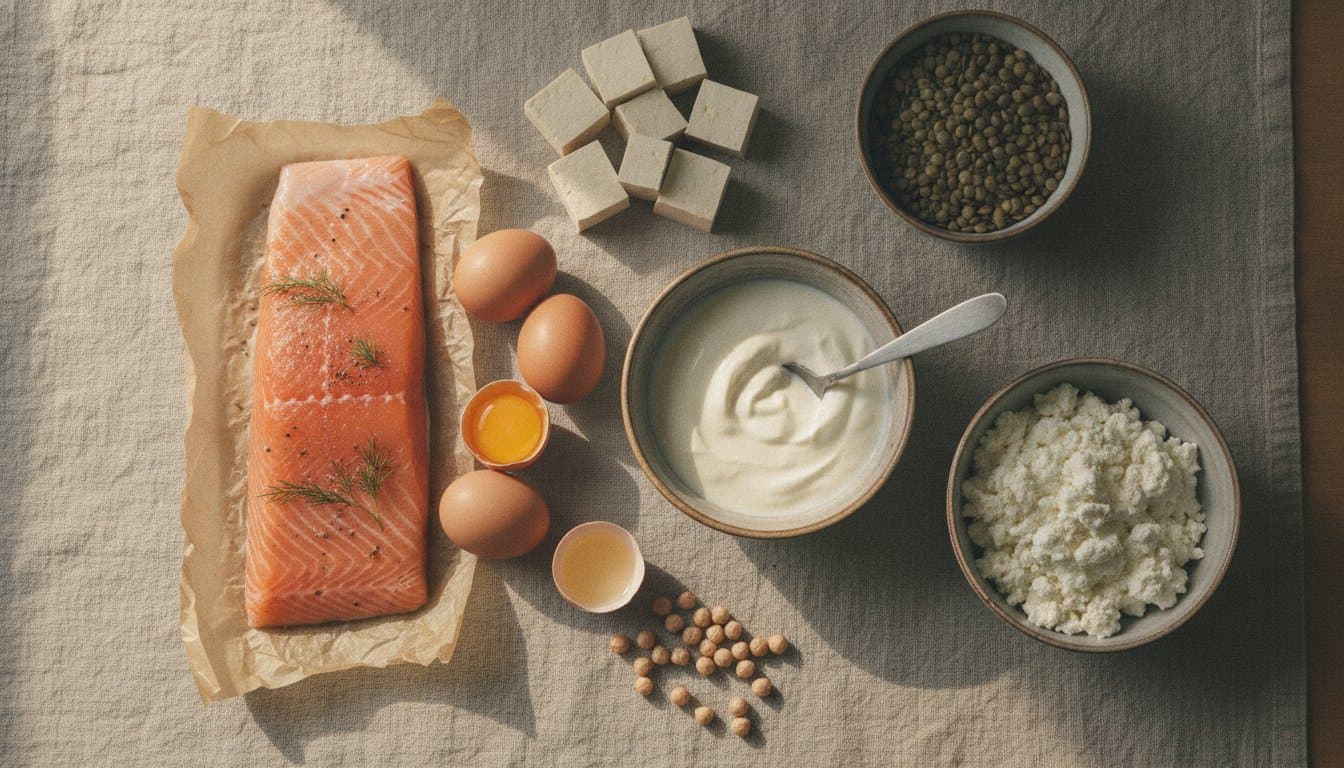
Combine animal and plant sources in your diet. Animal products usually have a complete amino acid profile and high digestibility. Plant products additionally provide fibre, polyphenols, magnesium and potassium, but often require more variety.
| Product | Approximate protein content |
|---|---|
| Chicken breast, 100 g cooked | approx. 28 to 31 g |
| Salmon, 100 g | approx. 20 to 25 g |
| Eggs, 2 pieces | approx. 12 to 14 g |
| Plain skyr, 150 g | approx. 15 to 18 g |
| Semi-skimmed curd cheese, 150 g | approx. 25 to 30 g |
| Tofu, 180 g | approx. 20 to 25 g |
| Cooked lentils, 200 g | approx. 16 to 18 g |
| Cooked chickpeas, 200 g | approx. 16 to 18 g |
| Protein powder, 1 serving | usually 20 to 25 g |
Is protein powder necessary?
No. Protein powder is a tool, not an obligation. It can be helpful if a woman struggles to hit her protein target from meals, eats little in the morning, trains and needs a convenient snack, or is dieting and wants more satiety without a large volume of food.
Choose products with a simple composition, without much sugar and with a well-tolerated type of protein. For women with lactose intolerance, whey protein isolate, plant protein or pea and rice blends may work better.
Summary
For a healthy adult woman, the starting point is about 0.8 g of protein per kg of body weight per day, and this is the minimum. In practice, the requirement depends on physiological state and physical activity level. For women who are active, strength train, are losing weight or are perimenopausal, a higher intake is usually recommended, most often in the range of 1.2 to 2.0 g/kg/day.
The best results come not from simply "hitting your protein", but from spreading it well across the day, choosing quality sources and combining it with strength training, sleep, appropriate calorie intake and a fibre-rich diet.
Frequently asked questions
How much protein does a woman need per day?
The baseline requirement for a healthy adult woman is about 0.8 g of protein per kg of body weight per day. Women who are active, strength train, are losing weight or are over 50 usually benefit from a higher range, most often 1.2 to 2.0 g/kg per day.
How should protein be spread across the day?
Evenly, with 20-35 g of protein in each meal, rather than catching up at dinner. Example: a woman weighing 65 kg with a target of 1.6 g/kg needs about 104 g of protein per day, which works out to 4 servings of about 25 g each.
How much protein does a 70 kg woman need per day?
At the baseline of 0.8 g/kg that is about 56 g per day, but a 70 kg woman who is active or losing weight usually lands between 1.2 and 1.6 g/kg, which works out to roughly 84 to 112 g of protein per day, split into 3 to 4 meals.
Is protein powder necessary?
No, it is a tool, not an obligation. It can help when it is hard to reach the protein target from meals, breakfasts are small or during weight loss. Choose products with a simple composition and little sugar; with lactose intolerance, whey isolate or plant protein may work better.
References
- Institute of Medicine, Dietary Reference Intakes, recommended macronutrient intake table NCBI Bookshelf.
- EFSA, Population Reference Intakes for protein EFSA.
- Jäger R. et al., International Society of Sports Nutrition Position Stand: protein and exercise Journal of the International Society of Sports Nutrition.
- Morton R.W. et al., Protein supplementation and resistance training, systematic review and meta-analysis British Journal of Sports Medicine.
- Sims S.T. et al., ISSN Position Stand: nutritional concerns of the female athlete PubMed.
- Volkert D. et al., ESPEN practical guideline: Clinical nutrition and hydration in geriatrics ESPEN.
- Kokura Y. et al., Enhanced protein intake on maintaining muscle mass in adults with overweight or obesity, systematic review and meta-analysis PubMed.